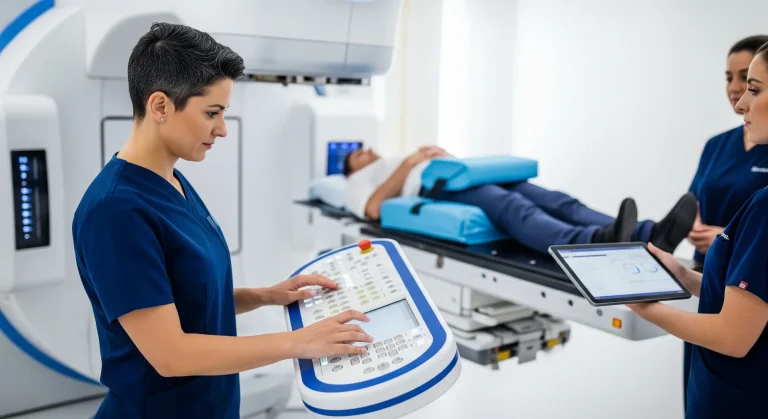

Personal protective equipment (PPE), such as lead aprons and thyroid collars, is a crucial part of radiation safety in medical settings. Equipment that emits radiation, like C-arms, fluoroscopy, and X-rays, is used frequently in diagnostic and interventional procedures. It’s important for healthcare workers regularly exposed to shield themselves appropriately.
While healthcare staff members may know that it’s important to use PPE in some scenarios, it can still feel confusing to know which garments are most necessary during different procedures and situations. For example, while rushing to prepare for surgery in an emergency response scenario, compared to performing a routine chest X-ray.
How do you decide what’s best for each procedure? Read on as we discuss relevant research and recommendations from governing bodies that can help.
What Are Examples of Personal Protective Equipment in Radiology?
When determining the right PPE for radiology staff members, it can help to have some examples of common protective garments used. OSHA’s guidelines for radiation control and prevention list several types of PPE for radiation shielding that can help protect different parts of the body, including:
Lead Aprons
A lead apron hangs from the shoulders to just above the knees to protect crucial organs along the torso, such as the breasts, gonads, heart, and lungs. A study published in the Journal of Clinical Orthopedic Trauma found that 0.5 mm lead aprons could attenuate up to 99% of radiation, so they’re highly effective in several diagnostic and interventional settings.
Thyroid Collars
A thyroid collar wraps around the neck to shield the sensitive thyroid gland. Research in the Korean Journal of Pain found that a 0.5 mm thyroid shield could reduce radiation doses by up to 2.5 times, making them highly effective for any procedures where the neck is exposed to the radiation source.
Lead Gloves
Many procedures involve the clinician’s hands getting close to the radiation beam, so wearing lead gloves can help reduce exposure levels.
However, OSHA notes that it isn’t a good idea to wear lead gloves in the direct line of the radiation beam while using fluoroscopy units with automatic controls. The dense lead can trigger the equipment to increase the intensity substantially, making anyone present in the room more exposed to radiation.
Lead Glasses
A physician’s eyes may also be exposed to radiation during many diagnostic and interventional procedures, such as while leaning over a patient to operate while a fluoroscopy tube is capturing a real-time image. Lead glasses are an option that can help shield the eyes in those situations. A study in Physica Medica found that 0.75 mm lead glasses could reduce radiation doses to the eyes by 1.6 times.
How To Find Out the Correct PPE for Any Type of Radiology Job
Finding the appropriate PPE for any procedure in radiology requires assessing several elements, such as how close clinicians are to the radiation source, the duration of the procedure, the level of intensity of the equipment being used, and the body parts exposed.
A study published in February 2025 in Ecancer Medical Science recommended that facilities consult with their radiation safety officer (RSO) to assess individual procedure needs and determine the right PPE for each job.
The study also stressed the importance of proper training for all new healthcare workers. The RSO should oversee new employee onboarding to ensure they receive proper radiation safety training, including equipment selection for different types of procedures.
Well-rounded training can help clinicians quickly select the necessary protective garments during emergency situations and ensure compliance throughout the facility.
PPE Selection by Scenario
Choosing the right personal protective equipment starts with a thorough hazard assessment of each procedure and clinical environment. Proper PPE selection cannot be standardized across all roles because the hazards present in a fluoroscopy suite differ significantly from those in a routine X-ray room or an emergency response scenario.
Radiology and Interventional Procedures
A thorough hazard assessment for high-intensity procedures should account for radiation intensity, proximity to the source, and procedure duration. Proper PPE in these settings typically includes:
- Full lead aprons and thyroid collars for torso and neck protection
- Lead glasses or safety glasses with lead equivalence to protect against scatter radiation
- Radiation protection gloves when hands are near the X-ray beam
- Respiratory protection if additional environmental or infectious hazards are present alongside radiation
Emergency Scenarios
Workplace safety protocols for unplanned procedures should be established in advance so staff can select proper PPE quickly without relying on real-time judgment. Recommended practices include:
- Pre-assigned PPE kits organized by clinical role to reduce gaps in protection during high-urgency situations
- Clear guidelines developed with the RSO so every team member knows their personal protective equipment requirements before an emergency occurs
Diagnostic Imaging Rooms
For lower-intensity procedures like routine X-rays, a hazard assessment may determine that fewer garments are required. Proper PPE selection in these settings generally includes:
- A standard lead apron and thyroid collar for staff positioned at a safe distance from the beam
- Safety glasses for procedures where scatter radiation reaches the eye level of the clinician
Key Factors for Proper PPE Selection
Regardless of scenario, a thorough hazard assessment should always drive garment choice rather than habit or availability. Additional considerations include:
- Fit and compatibility across garments to ensure safety glasses, thyroid collars, and lead aprons do not interfere with each other or restrict necessary movement
- Consistent workplace safety training so all staff understand how to inspect, maintain, and replace personal protective equipment throughout its lifespan
- Regular reassessment as procedures, equipment, or staffing roles change within the facility
How Do You Match PPE to Different Clinical Roles and Emergency Scenarios?
PPE selection should be performed on a procedure-by-procedure basis and based on the varying roles that healthcare workers have in an operating room, since their proximity and level of exposure to the radiation source may be different.
For example, the International Atomic Energy Agency (IAEA) states that everyone in a fluoroscopy room (except for the patient) should wear a lead apron to shield against radiation. However, the type of lead apron can vary depending on different needs.
For instance, the IAEA’s recommendations mention that lighter 0.35 mm lead aprons may be sufficient for lower-intensity procedures, but thicker 0.5 mm lead aprons should be used for more intense operations where radiation exposure is higher.
What Factors Should You Consider When Selecting Radiation Protection Equipment?
Based on the recommendations from the IAEA, factors to consider during radiation protection equipment selection include:
- The type of procedure and its intensity
- The location and angle of the X-ray beam
- Clinicians’ distance from the radiation source
- The duration of each procedure
Consulting with your facility’s RSO is a good idea to ensure you select the proper PPE for each scenario and have established radiation safety guidelines for specific procedures.
How Can RCS Help You Choose Appropriate PPE for Your Facility?
At RadCare Services (RCS), we know that selecting the right PPE for radiation and finding high-quality options from manufacturers can feel confusing. We can act as a partner in the process to ensure you secure the right protective garments for your needs.
We work with several high-quality manufacturers that produce different types and styles of radiation protection equipment, including lead aprons, thyroid collars, glasses, gloves, vests, and skirts. We can work with you to select PPE that’s the right fit for your needs, inspect it for any defects, tag it, and ensure it arrives at your facility ready for use.
Additionally, we offer several services to help maintain PPE for radiation throughout its lifespan, including:
- Deep cleaning and disinfection
- Inspections using X-ray scanning
- Garment repairs
- Garment disposal
- Inventory management with our RadComply® software
Each of our services is designed to help busy healthcare facilities operate efficiently while keeping protective garments in top condition.
Contact us today to learn more about how RCS can help.