Ready to Wear on Arrival

Shop All X-Ray Garments and Radiation Protection Equipment

RCS partners with leading manufacturers, including Burlington and Techno-Aide, to provide hospitals with comprehensive radiation protection solutions from lead vests and aprons to thyroid shields, protective eyewear, positioning sponges, and mobile barriers. When you purchase through RCS, every garment arrives pre-tagged, X-ray scanned, and loaded into RadComply® for immediate inventory tracking and seamless service integration with your existing equipment.

Get a Quote

Most vendors ship a box. We deliver gear that’s X-ray scanned, tagged in RadComply, and sized to fit, so your team can use it straight out of the box. RCS can even come onsite to fit your staff, ensuring every garment is safe and comfortable.

This field is for validation purposes and should be left unchanged.
Name(Required)
What brands are you most interested in?
This field is hidden when viewing the form

Scanned for Safety

All garments from RCS undergo X-ray integrity scanning before leaving our facility, ensuring there are no manufacturing errors. You receive gear that’s verified to protect, not just assumed to.

Logged in RadComply

We tag and inventory every garment in RadComply before it reaches you—so it arrives labeled, documented, and ready for audit. No mystery aprons, no manual entry, no wasted time.

Fitted for Your Team

X-ray garments only do their job if they actually fit. Our team is trained to fit your team and can come on-site to ensure every staff member is properly protected from day one.

Ready to Wear

No more unpacking a box of lead and realizing you’ve still got work to do. RCS garments arrive tagged, inspected, inventoried, and ready to use.

Why garment prep and management matter

Compliance-Ready from Day One

The right gear is only part of the equation—how it’s managed is just as critical. At RCS, every garment we sell is X-ray scanned, tagged, and inventoried in RadComply®. When you buy from RCS, you don’t just get garments—you get gear that’s tracked, trusted, and truly ready to wear out of the box.

  • Tagged
  • Scanned
  • Inventoried

Why RCS?

Brand Agnostic:

Invest in the right equipment for your needs with various options available from our four partner Radiation Protective Equipment (RPE) manufacturers.

Lead garments arrive ready to use:

RCS will X-ray scan, tag, and inventory your garments in RadComply™ before shipping.

Dedicated RPE Team:

We strive to provide the best customer service by offering sizing and fitting assistance and preferred turnaround times.

What To Consider When Purchasing a Lead Apron

Selecting the right radiation protection equipment ensures staff comfort, safety, and compliance with your facility’s specific needs.

Talk with a RadCare Specialist

Lead Equivalency and Protection Level

Lead aprons are available in 0.25mm, 0.35mm, and 0.5mm lead equivalency, with 0.5mm providing the highest protection level and blocking approximately 95-99% of scatter radiation. Your department’s exposure levels and procedure types will determine which protection level is appropriate for your team.

Weight and Material Options

Standard lead aprons are the heaviest option, while lead-composite and lead-free alternatives can be 16-40% lighter while maintaining the same protection levels. Lighter-weight options reduce fatigue and upper back stress, making them especially suitable for staff wearing protection during long interventional procedures or all-day in the OR.

Style and Coverage Type

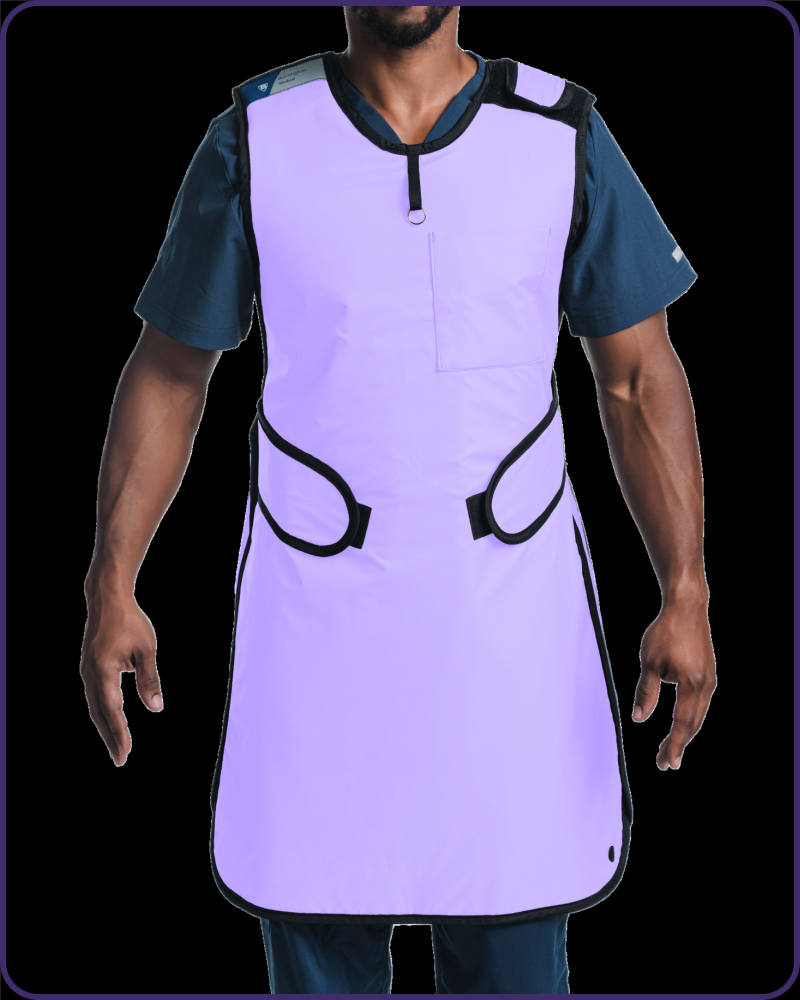
Front protection aprons provide quick on-off convenience for shorter procedures, while wrap-around or vest and skirt combinations offer 360-degree protection for staff with their backs exposed to scatter radiation. Consider your team’s procedural environment and positioning when selecting between frontal, wrap, or two-piece protection styles.

Comfort Features and Fit

Proper fit and weight distribution significantly impact long-term wearability and staff compliance with radiation safety protocols. Look for features like adjustable closures, padded shoulders, ergonomic design, and sizing options that accommodate your team’s range of body types to ensure garments are worn consistently and correctly.

RCS Insights

“When choosing a lead apron, comfort and practicality matter just as much as protection.

Frontal aprons are a top pick for their lightweight feel, making them ideal for quick procedures and easy on-and-off wear—especially when paired with modern lead-free materials. They’re also a great option for a range of body types, including pregnant professionals.

If you need something even more adaptable, some styles, like drop-lead aprons, are perfect for fast-paced ER settings. There are also styles for pregnant professionals.

However, if you’re spending long hours around radiation or need full-body protection, a full-wrap apron or a vest and skirt combo will provide better coverage without sacrificing comfort.”

Justin McKay

Co-Founder of RCS

We Don’t Just Sell Gear – We Help You Care For It

We get it – lead apron management is at the bottom of your to-do list. We’re here to help. RCS is the only provider offering end-to-end X-ray garment care, including:

  • Deep cleaning and Disinfection
  • Repairs
  • Inventory Management (RadComply®)
  • Annual X-ray Scans
  • Garment Disposal

Learn More About Our Services

Frequently asked questions

Our process goes beyond wipes. Following guidelines from regulatory bodies, our cleaning process is two steps.
First step: Garments are tested then cleaned using friction.
Second step: Garments are properly disinfected.
The method is proven effective as a bactericidal, viricidal, fungicidal, and sporicidal solution for X-ray garments.
It is also endorsed by garment manufacturing companies and yields best practice outcomes as defined by AORN, TJC, and CDC.

Our process goes beyond wipes. Following guidelines from regulatory bodies, our cleaning process is two steps.
First step: Garments are tested then cleaned using friction.
Second step: Garments are properly disinfected.
The method is proven effective as a bactericidal, viricidal, fungicidal, and sporicidal solution for X-ray garments.
It is also endorsed by garment manufacturing companies and yields best practice outcomes as defined by AORN, TJC, and CDC.

Our process goes beyond wipes. Following guidelines from regulatory bodies, our cleaning process is two steps.
First step: Garments are tested then cleaned using friction.
Second step: Garments are properly disinfected.
The method is proven effective as a bactericidal, viricidal, fungicidal, and sporicidal solution for X-ray garments.
It is also endorsed by garment manufacturing companies and yields best practice outcomes as defined by AORN, TJC, and CDC.

Our process goes beyond wipes. Following guidelines from regulatory bodies, our cleaning process is two steps.
First step: Garments are tested then cleaned using friction.
Second step: Garments are properly disinfected.
The method is proven effective as a bactericidal, viricidal, fungicidal, and sporicidal solution for X-ray garments.
It is also endorsed by garment manufacturing companies and yields best practice outcomes as defined by AORN, TJC, and CDC.

Our process goes beyond wipes. Following guidelines from regulatory bodies, our cleaning process is two steps.
First step: Garments are tested then cleaned using friction.
Second step: Garments are properly disinfected.
The method is proven effective as a bactericidal, viricidal, fungicidal, and sporicidal solution for X-ray garments.
It is also endorsed by garment manufacturing companies and yields best practice outcomes as defined by AORN, TJC, and CDC.

Find Something You Like?

Our team will help you select the right protection equipment for your facility’s specific needs and budget. Request a quote today and receive expert guidance on lead equivalency, sizing, style options, and product selection that works best for your departments.

Request a Quote

Frequently asked questions

We do! We distribute aprons, vests, kilts, thyroid guards, leaded glasses, protective gloves, protective sleeves, barriers, shields, apron racks, positioning sponges, table pads and more.

We offer full wraparound, frontal, vest & skirt styles, and other lead garment accessories, such as thyroid collars, glasses, gloves and more.

Several factors should be considered when choosing the right apron, including the fit, comfort, level of protection needed, use case, attenuation material, and price. To determine the level of protection you need, consider the intensity of radiation, energy level, duration of exposure, and the specific body area that need protection.

Fortunately, our expert team will guide you through the process!

An apron should be snug to your body to distribute the weight evenly.

  • Neckline Height: The neckline should be high enough to provide seamless protection with a thyroid collar.
  • Armholes: Should be snug but not restrict arm movement. Armholes should also cover axillary lymph nodes, as these are sensitive areas for radiation exposure.
  • Shoulder Panel Width: Should be wide enough to distribute weight across the shoulder without restricting movement or causing discomfort.
  • Overlap: For aprons relying on overlapping panels, each panel should provide full protection without relying solely on the overlap.
  • Length: The aprons should cover the collar and just below the knee.
  • Thyroid collar: This should fit snugly against the neck but not be uncomfortable and provide some overlap with the top of your vest or apron.

We offer the same customization options the manufacturers provide.

Lead aprons are sold with the manufacturer return and exchange policy.

RCS’s EPA-approved garment disposal process provides hospitals a quick, easy, and responsible option for disposing of lead garments. Contact us to learn more.

Lead-free aprons are growing in popularity as a lighter-weight and non-toxic alternative. The attenuation is a blend of other heavy metals, such as aluminum, antimony, barium, bismuth, tin, titanium, or tungsten.

These options are not as heavy as lead aprons and create less environmental pollution when recycled.

The price range for lead aprons varies widely, mostly depending on the manufacturer. Consult your sales representative on the best option for your budget.

RCS provides lead garments and radiation protection equipment from several leading manufacturers. We can help you determine the best equipment for your needs, regardless of the manufacturer.

A lead apron’s lifetime is determined by how well it is taken care of and the material it’s made from. Some last a decade, others won’t last more than a year.

A study published in 2015 shows that lead aprons are typically too damaged for use between 6-9 years.

While preparing for an X-ray, you may have come across information about how medical imaging equipment emits scatter radiation. 

Many clinicians wear personal protective equipment (PPE), such as lead aprons, to shield against radiation exposure during X-rays and interventional procedures using fluoroscopy or C-arms. However, is there x ray protective clothing for patients? Wearing x ray protective clothing, such as lead aprons and thyroid shields, helps minimize exposure to ionizing radiation.

Generally, the radiology PPE and patient safety measures depend on the procedure and individual needs. The rest of this article will provide everything you should know about X-rays and interventional safety measures so you can feel confident before diagnosis or interventional surgery.

X-ray protective gear shields against radiation emitted from medical imaging equipment. The most common types of gear on radiation safety equipment lists are:

  • X-ray protection aprons: The Journal of Clinical Orthopedic Trauma states that the typical X-ray protective apron should drape from the shoulders down to within 10 cm of the knees. It protects many areas of the body that are most sensitive to radiation, such as the breasts and reproductive organs.  X ray shielding is essential to limit radiation exposure during prolonged procedures.
  • Thyroid collar: The Journal of Endocrine Reviews states that the thyroid is one of the most sensitive organs to radiation. Therefore, wearing a thyroid collar is essential when regularly exposed to equipment emitting radiation. 
  • Protective surgical gloves: Gloves aren’t always worn during short X-rays but may be used during interventional surgery. The Asian Spine Journal states that certain procedures that use fluoroscopy, such as myelography, selective nerve root block, and facet joint block, place the surgeon’s hands close to the radiation source, making them more susceptible. Protective gloves are a major piece of radiation protection gear.
  • Protective goggles: The Journal of Radiology Research and Practice states that regular interventional surgery using C-arms and fluoroscopy can put a physician’s eyes at risk of developing cataracts or lens opacities. Therefore, wearing protective goggles or ray protective glasses to shield the eyes is essential.

It’s important to note that radiology personal protective equipment use is most important for clinicians and other staff members exposed to radiation sources regularly. It isn’t always as common for patients to wear PPE, and it depends on a case-by-case basis. For example, the International Atomic Energy Agency (IAEA) states that everyone in a fluoroscopy room should wear a lead apron except the patient. Still, using radiation PPE equipment when possible can help minimize exposure.

Lead is the most common shielding material used in PPE, such as lead aprons. Research from the Journal of Clinical Orthopedic Trauma states that lead effectively shields the body from radiation beams due to its high density. A 0.5 mm lead apron can attenuate up to 99% of scatter radiation. 

However, other materials are becoming more popular. Research from the European Journal of Radiology found that alternative materials like antimony, tin, bismuth, tungsten, yttrium, copper, or barium perform similarly to lead in low-intensity procedures. Although, as the strength of radiation beams increased, traditional lead performed slightly better. 

Traditional lead is still the most common material used for shielding in radiology. It’s been used for decades, and lots of research, such as studies from Heliyon and the Korean Journal of Pain, show that lead aprons are highly effective at attenuating radiation from ray machines.

That said, the main problem with lead aprons is their weight. Lead aprons can weigh 10 pounds or more, which can cause clinicians to experience fatigue and joint stress during long procedures. 

Therefore, more clinicians are opting for aprons containing alternative materials like antimony or bismuth, which are lighter while providing similar levels of protection. 

Regular radiology PPE testing and maintenance are essential to keep protective gear clean and performing at its best. 

During ongoing use, PPE like lead aprons can develop small tears, cracks, or holes that reduce effectiveness. A study from the Journal of Health Physics showed that damage can progress rapidly, with tears increasing by over 270% in 10 months. Therefore, annual inspections using X-ray scanning are essential to identify damage early and perform necessary repairs. 

Regular deep cleaning and disinfection that go beyond wiping down aprons after use are also crucial. A study by Dr. Jaber from Wayne State analyzed 25 lead aprons in a medical facility, finding that 84% were colonized with Tinea species (ringworm) and Staphylococcus aureus, and 12% were colonized with MRSA.

We can help with each of these aspects at Radiological Care Services (RCS).

It can be challenging and costly for busy medical facilities to keep up with regular inspections and deep cleaning for lead aprons and other PPE. However, you don’t have to do it all on your own. Our services at RCS will make the process easier to manage. We offer:

  • Annual inspections using X-ray scanning
  • Deep cleaning and disinfection
  • Garment repairs
  • Lead apron disposal and equipment purchases

When you partner with us, you get access to our RadComply™ inventory software that our team maintains for you. Plus, all our inspections are compliant and thorough, so your staff and patients have a safe and effective experience during all procedures. 

Contact us today to learn more about how RCS can help.