
Shop Maternity Aprons for Radiation Protection during Pregnancy
Maternity lead aprons provide enhanced protection for expectant clinicians working in fluoroscopy, interventional radiology, cath lab, and other high-scatter environments. Designed with expanded frontal shielding and adjustable panels, these aprons safeguard both the wearer and the fetus while remaining comfortable throughout all trimesters. Lightweight core materials, ergonomic shaping, and supportive closures help reduce fatigue and allow pregnant clinicians to move freely and safely during procedures.
Find Something You Like?
Our team will help you select the right protection equipment for your facility’s specific needs and budget. Request a quote today and receive expert guidance on lead equivalency, sizing, style options, and product selection that works best for your departments.

Scanned for Safety
All garments from RCS undergo X-ray integrity scanning before leaving our facility, ensuring there are no manufacturing errors. You receive gear that’s verified to protect, not just assumed to.
Logged in RadComply®
We tag and inventory every garment in RadComply before it reaches you—so it arrives labeled, documented, and ready for audit. No mystery aprons, no manual entry, no wasted time.
Fitted for Your Team
X-ray garments only do their job if they actually fit. Our team is trained to fit your team and can come on-site to ensure every staff member is properly protected from day one.
Ready to Wear
No more unpacking a box of lead and realizing you’ve still got work to do. RCS garments arrive tagged, inspected, inventoried, and ready to use.
Why garment prep and management matter
Compliance-Ready from Day One
The right gear is only part of the equation—how it’s managed is just as critical. At RCS, every garment we sell is X-ray scanned, tagged, and inventoried in RadComply®. When you buy from RCS, you don’t just get garments—you get gear that’s tracked, trusted, and truly ready to wear out of the box.
- Tagged
- Scanned
- Inventoried
What To Consider When Purchasing a Maternity Lead Apron
Selecting the right radiation protection equipment ensures staff comfort, safety, and compliance with your facility’s specific needs.
Lead Equivalency and Protection Level
Maternity lead aprons are designed to offer enhanced protection for both the clinician and the fetus, which is why most models feature higher frontal protection—typically 1.0 mm Pb-equivalent. This added shielding helps reduce scatter exposure during fluoroscopy and interventional procedures. Your Radiation Safety Officer can help confirm what protection level is appropriate, but most expectant clinicians opt for the highest available attenuation for added peace of mind throughout pregnancy.
Weight and Material Options
Because comfort becomes even more important during pregnancy, material choice can make a big difference. Lightweight composite and lead-free materials help reduce strain on the shoulders, back, and hips while offering similar protection as traditional lead. These lighter options are especially helpful for clinicians who remain in a lead apron for long stretches of time or perform procedures that require frequent movement.
Style and Coverage Type
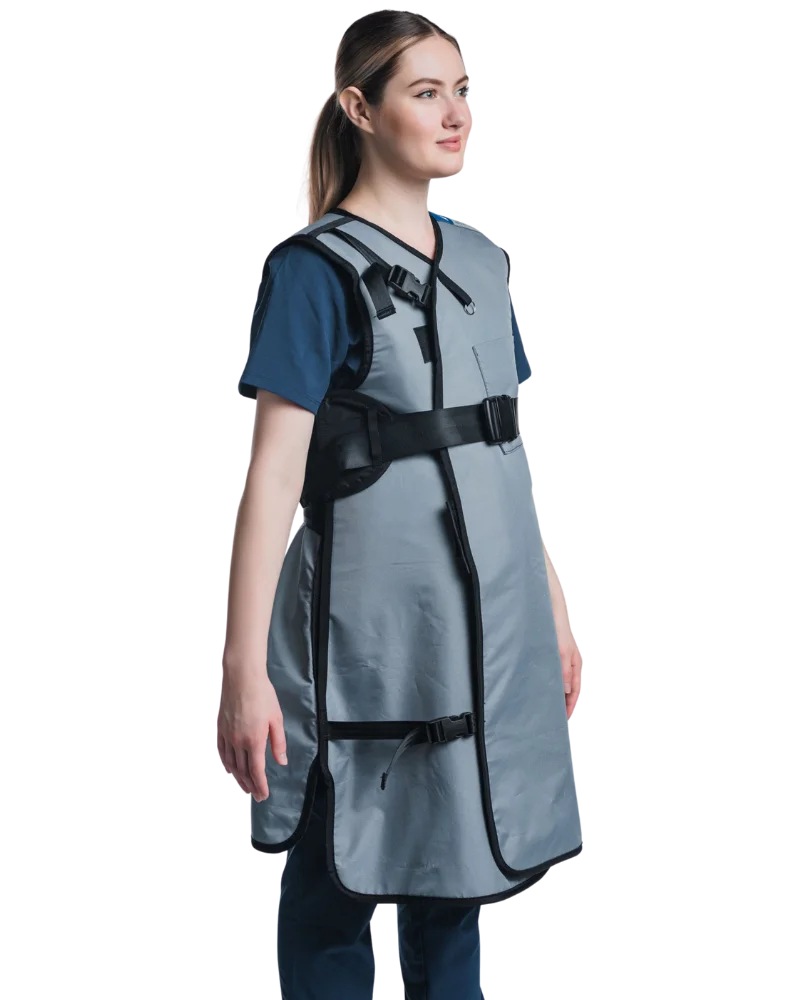
Maternity aprons are typically frontal aprons with extra belly coverage to protect the fetus, though some facilities also pair them with a half apron for additional shielding as pregnancy progresses. One-piece maternity aprons tend to be more comfortable and easier to adjust than two-piece systems during pregnancy. As always, the right choice depends on how much scatter exposure the wearer encounters and how often they turn or rotate during procedures.
Comfort Features and Fit
A good maternity apron should adjust easily throughout each trimester. Look for features like expandable side panels, soft padded shoulders, ergonomic contouring, and adjustable closures that accommodate a changing body without creating pressure points. A comfortable, well-fitting apron not only helps reduce fatigue but also ensures consistent protection every time it’s worn.

RCS Insights
We Don’t Just Sell Gear – We Help You Care For It
We get it – lead apron management is at the bottom of your to-do list. We’re here to help. RCS is the only provider offering end-to-end X-ray garment care, including:
- Deep Cleaning and Disinfection
- Repairs
- Inventory Management (RadComply®)
- Annual X-ray Scans
- Garment Disposal

Get a Quote
Most vendors ship a box. We deliver gear that’s X-ray scanned, tagged in RadComply, and sized to fit, so your team can use it straight out of the box. RCS can even come onsite to fit your staff, ensuring every garment is safe and comfortable.
Maternity Lead Aprons FAQ
-
What is the best lead apron for pregnant healthcare workers?
Pregnant healthcare workers may want to consider maternity lead aprons, which are designed to provide full abdominal and pelvic coverage. They often feature adjustable straps to accommodate body changes throughout pregnancy.
While standard front-protection aprons provide reliable coverage for many situations, lead aprons specifically designed for pregnant users are designed to provide improved fetal coverage. The best lead apron for pregnancy is one with greater shielding, like a 0.5mm to 1.0mm lead equivalency, that features a full wrap or overlapped front protection to improve fetal coverage. It should also distribute the weight on the shoulders, provide back support for comfort, and be adjustable from early through late pregnancy.
-
Can pregnant healthcare workers wear lead aprons and safely continue working in radiology?
With appropriate precautions, equipment, and oversight, many pregnant clinicians are able to continue working in radiology safely. Regulatory guidance limits fetal exposure to no more than 0.5 rem (5 mSv) over the course of a pregnancy, and a 0.5mm lead apron can significantly reduce scatter radiation exposure by absorbing 96-98% (depending on the garment).
When properly fitted, maternity lead aprons may help provide additional reassurance and protection for clinicians who remain in radiation environments during pregnancy. That said, the decision to continue working around radiation should be made on an individual basis, in consultation with the clinician’s care team and the facility’s radiation safety officer.
In addition to wearing a maternity-specific lead apron, pregnant healthcare workers should also monitor their exposure and limit high-risk tasks (like time spent in direct fluoroscopy).
-
How much radiation protection do maternity lead aprons provide?
Studies have shown that maternity lead aprons notably reduce radiation exposure. Maternity lead aprons with 0.5mm lead equivalency provide approximately 96% attenuation of scatter radiation, for example, while 1.0mm lead equivalency aprons provide about 98% attenuation.
-
How effective are pregnancy lead aprons?
Maternity lead aprons are considered to be effective, as long as they provide adequate lead equivalence and fit correctly. When properly fitted to cover the entire abdomen and pelvis, maternity lead apron radiation protection is effective, minimizing fetal radiation exposure to protect both mother and baby.
-
When should pregnant healthcare workers start wearing maternity lead aprons?
Since maternity lead aprons provide improved fetal radiation protection than standard lead aprons, it’s worth knowing when to wear a maternity lead apron.
The short answer is, as soon as possible.
Ideally, this will occur within the first trimester of the pregnancy, which is when fetal radiation sensitivity is at its highest. Because maternity lead aprons are designed to adapt their fit as pregnancy progresses, they can provide consistent protection for the duration of the pregnancy.
-
What's the difference between maternity lead aprons and regular lead aprons?
The key difference between a maternity and standard lead apron is in the design, as maternity lead aprons are made with extended front coverage to protect the entire abdomen and pelvis area where the fetus develops.
Another important maternity lead apron vs regular lead apron point of comparison is in how the garment fits. Maternity lead aprons typically include adjustable closures and elastic panels that expand in order to accommodate body changes throughout pregnancy without compromising the level of protection. They also feature improved weight distribution systems, which reduce physical strain during pregnancy.
-
How should pregnant healthcare workers care for and maintain maternity lead aprons?
Proper lead apron maintenance helps to ensure that all healthcare workers, including (and especially) pregnant women, are adequately protected from radiation. It’s important to know how to clean maternity lead aprons, for example, (with deep cleaning and disinfection, not just surface wipes!), but that’s just one piece in the puzzle. In addition to deep cleaning and disinfection, regular inspections and proper storage are also vital.
At a minimum, appropriate maternity lead apron maintenance requires three key elements: regular inspections, deep cleaning and disinfection, and proper storage.
- Regular inspections: It’s natural, and expected, for lead garments to experience wear and tear during use. Regular inspections help to ensure that “wear and tear” factors aren’t having an impact on how the garment fits. Inspections are also necessary to identify early signs of cracks, holes, or tears forming, which can seriously reduce a garment’s effectiveness. The best method for inspecting lead aprons is through X-ray scanning, which can identify small points of damage before they can compromise their ability to protect the user, rather than merely visual or tactile inspections.
- Deep cleaning and disinfection: It’s not unusual for PPE like lead aprons to be exposed to harmful microorganisms that can be difficult to remove. The Association of periOperative Registered Nurses (AORN) has outlined specific guidelines that recommend deep cleaning (which goes well beyond surface wipes) for other high-touch objects on at least a quarterly basis. (You can learn more about how to clean lead aprons and prevent infections here.) They recommended that protective garments should be cleaned and disinfected before and after each use to ensure proper infection control.
- Proper storage: In addition to regularly inspecting, cleaning, and disinfecting maternity lead aprons, proper storage is another essential component of proper care and maintenance. Folding or creasing lead aprons, on the other hand, is not recommended, as it tends to cause cracks or tears to form in their protective material, especially over time.
Instead, lead aprons should be stored using wide, heavy-duty hangers that can accommodate 10 or more pounds. We recommend steel hangers with upturned edges, since they’re able to keep garments centered and secure.
RadCare Services provides comprehensive maternity apron care, including regular X-ray scans, complimentary repairs, cleaning and disinfection, and inventory tracking through our proprietary RadComply® platform.
-
What are the regulatory requirements for protecting pregnant workers from radiation?
Federal pregnancy radiation safety regulations protect pregnant workers from excessive radiation exposure. Employer requirements include monitoring pregnant workers’ cumulative dosage and making reasonable accommodations to work assignments (in accordance with the Pregnant Workers Fairness Act, which went into effect in 2023).
Pregnant worker radiation limits
On a federal level, the U.S. Nuclear Regulatory Commission (NRC) recommends a dose limit of 5 mSv of radiation throughout the duration of the pregnancy, a level substantially lower than comparable regulations for non-pregnant workers. Additionally, the International Commission on Radiological Protection (ICRP) recommends a dose limit of 1 mSv of exposure during the entire pregnancy, and the National Council on Radiation Protection (NCRP) recommends a dose limit of 0.5 mSv per month throughout the pregnancy.
You can learn more about these regulations (and more) in this OSHA article.
The ALARA principle
As outlined by the Centers for Disease Control (CDC), the ALARA (“as low as reasonably achievable”) principle provides generalized guidance for radiation safety that is applicable to pregnant as well as non-pregnant healthcare workers. This principle refers to a combination of three basic protective measures when working with radiation, in order to minimize exposure: time, distance, and shielding.
- Time: Do not spend more time near radiation than is necessary. When you must work near radiation, complete the work and then leave the area when finished.
- Distance: The less time you can spend near a source of radiation, the better. The further you can be from the source, the lower the dose.
- Shielding: Effective shielding, through the use of PPE such as lead aprons, significantly reduces the level of danger. Refer to the guidelines described above for more information about what constitutes “effective shielding.”
-
Where can healthcare facilities purchase or service maternity lead aprons?
Maternity lead aprons and related PPE can be purchased from a range of specialized medical suppliers, including RadCare Services (RCS). Since care and maintenance are essential to the effectiveness of lead aprons, it’s best to work with a supplier that not only sells lead aprons but also provides comprehensive cleaning, inspection, and maintenance services.
Unlike other maternity lead apron suppliers, RCS is the only full-service X-ray garment care platform in the country. RCS provides the equipment and services to ensure that regulations are met and healthcare workers are protected, including specialized lead apron care and maintenance. Our services include:
- Deep cleaning and disinfection
- Annual X-ray integrity scans
- Complimentary repairs
- Inventory tracking with RadComply®
- EPA-compliant disposal services
Contact us today to learn more about our maternity apron solutions and how comprehensive garment management services through RCS can ensure that all workers have access to PPE that will keep them truly safe and your facilities compliant.