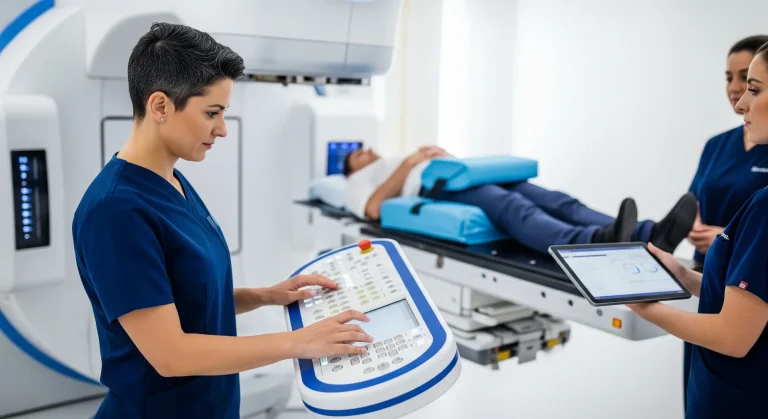

Radiation exposure is important to manage in medical facilities when clinicians are frequently exposed to it during diagnostic imaging or interventional procedures using X-rays, C-arms, or fluoroscopy.
Due to those exposure risks, radiation safety compliance awareness is crucial. It can help both healthcare workers and patients remain protected as much as possible during procedures.
This guide will provide the essentials you should know about radiation safety compliance needs and how facilities can educate healthcare professionals so they use the required best practices during procedures.
Why Is Radiation Safety Compliance Awareness Important for Healthcare Workers?
The health risks of unmanaged occupational radiation exposure are one of the biggest reasons why compliance awareness is important. The World Health Organization (WHO) states that radiation doses that exceed established limits from governing bodies, such as OSHA, can increase the risk of cancer, skin damage, blood damage, cataracts, infertility, and birth defects.
Fortunately, taking precautions during healthcare procedures can reduce doses significantly. For example, a study from the Journal of Clinical Orthopedic Trauma found that wearing 0.5 mm lead aprons during diagnostic or interventional procedures could attenuate up to 99% of radiation.
Radiation safety knowledge is important for healthcare staff members so they’re aware of the risks and the steps they can take to protect themselves, such as wearing personal protective equipment (PPE) like lead aprons.
What Are the Basics of Radiation Safety for Healthcare Professionals?
One of the most common radiation safety practices recommended by governing bodies like the CDC is following the principles of ALARA (as low as reasonably achievable). ALARA outlines three basic rules of radiation safety that can help.
What Are the Three Basic Rules of Radiation Safety?
The three basic rules of radiation safety under ALARA are:
- Time: Reducing the amount of time exposed to radiation when possible. However, some procedures require extended durations of exposure, which is why other strategies are necessary to keep clinicians safe.
- Distance: Remain a safe distance away from the radiation source when possible. AORN recommends standing at least six feet from the radiation source when you can, but some interventional procedures will require physicians to stand right next to a fluoroscopy tube.
- Shielding: Using wearable PPE, such as lead aprons, thyroid collars, or glasses, or using mobile lead barriers during procedures to shield against the radiation source. The study mentioned before from the Journal of Clinical Orthopedic Trauma recommended wearing lead aprons during all high-dose interventional procedures since it provides effective protection when reducing time or increasing distance isn’t possible.
What Precautions Should Workers Take When Working With Radiation?
OSHA’s guidelines for radiation control and prevention provide several recommendations that can help healthcare workers minimize exposure during procedures:
- Follow the principles of ALARA, including wearing PPE, such as lead aprons, thyroid collars, and glasses.
- Wear personal dosimeters under PPE to monitor doses during each procedure.
- Keep detailed records of all personal dosimeter readings to accurately track accumulated doses.
- Conduct regular surveys of radiation safety programs and radiation levels to improve processes as needed.
- Implement strict controls for entering and exiting operating rooms to prevent unintentional radiation exposure.
- Provide detailed training on radiation protection, including the proper PPE to wear for procedures and the health risks of unmanaged radiation exposure.
- Follow established radiation dose limits closely, such as OSHA’s limit for exposure to the whole body, which is a maximum of 12.5 mSv per quarter or 50 mSv per year.
How Can Healthcare Facilities Improve Radiation Safety Compliance?
Establishing a comprehensive radiation safety program is essential to help healthcare workers build radiation knowledge and understand steps they can take to protect themselves.
Your facility’s radiation safety officer (RSO) can act as a great resource during this process to establish strict guidelines, continuously review their effectiveness, and monitor types of PPE and other strategies that can help reduce exposure across procedures.
How Does Professional X-Ray Garment Management Support Safety Compliance?
Managing garments throughout their lifecycle is another essential step that healthcare facilities should take to keep their staff and patients as safe as possible during procedures. Common maintenance and management needs for PPE include:
Inspections
One of the important steps facilities should take for all X-ray garments in use is to regularly inspect them for any defects present. A study from Radiography Open found that damage such as cracks, holes, or tears can reduce a garment’s effectiveness, so identifying and repairing it early is important. We recommend annual inspections using X-ray scanning to help with this.
Deep Cleaning and Disinfection
Garments, such as lead aprons, can also become contaminated with harmful microorganisms if they aren’t regularly deep cleaned and disinfected.
A study by Dr. Jaber of Wayne State found that 84% of lead aprons at a healthcare facility were contaminated with Tinea species (ringworm) and Staphylococcus aureus. Thorough deep cleaning and disinfection are necessary to completely remove tough microorganisms from the garment’s surface.
Garment Disposal
Lead garments must be disposed of according to strict regulations established by the EPA. Read our blog about the top 3 ways to dispose of lead aprons. Lead can become harmful to the environment and human health as it decomposes if it isn’t managed properly, which is why the EPA sets strict standards for documentation, transportation, and disposal facilities used.
How Our Services at RCS Can Help
Wearing PPE during procedures is an essential part of radiation safety in healthcare. However, it can become challenging for healthcare facilities to manage all the steps necessary to maintain and manage garments throughout their lifecycle. We offer services that can help make the process more efficient at RCS.
Our services include:
- Inspections using X-ray scanning
- Deep cleaning and disinfection
- Garment repairs
- Garment disposal
- Inventory management with our RadComply® software
All our services follow standards established by governing bodies, such as the CDC, EPA, and AORN, to ensure effective results and compliant processes.
We can also help you source new garments such as lead aprons, vests, skirts, thyroid collars, and glasses from high-quality manufacturers to keep your inventory up to date.
Contact us today to learn more about how our services at RCS can help with radiation safety compliance.