
Teaching Hospital | Texas | Cleanliness
Teaching Hospital – Texas
A prominent academic medical center in Texas didn’t come to RadCare Services with a compliance problem or an inspection gap. They came with a simpler problem: their lead was gross, and they needed it professionally cleaned.
The one hesitation was distance. Sending garments out of state to a service provider they hadn’t worked with before was a harder sell than the service itself.
The deep cleaning results were striking on their own. But the X-ray scanning turned up something the team hadn’t expected. A skirt that had been in active use came back with severe damage to the protective material, damage that hadn’t been flagged by their existing inspection process. The garment had been passing. It shouldn’t have been.
The findings traveled right up to senior leadership. The response was straightforward: this is a radiation safety and an infection risk, get it done.
Before
ATP test failed (15,295 RLUs), indicating residual bioburden and contamination.
Recommended threshold is 20 RLUs or less.
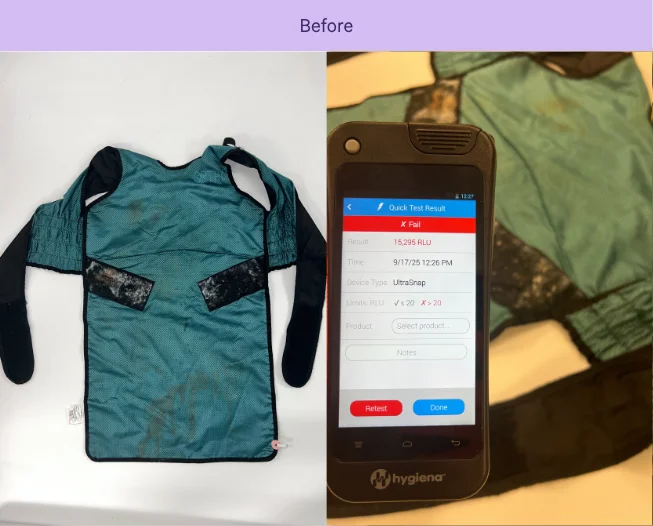
ATP Results
15,295 RLU
After
ATP test passed (0 RLUs), with all stains and bioburden removed.
Results demonstrate the effectiveness of the two-step deep cleaning process.
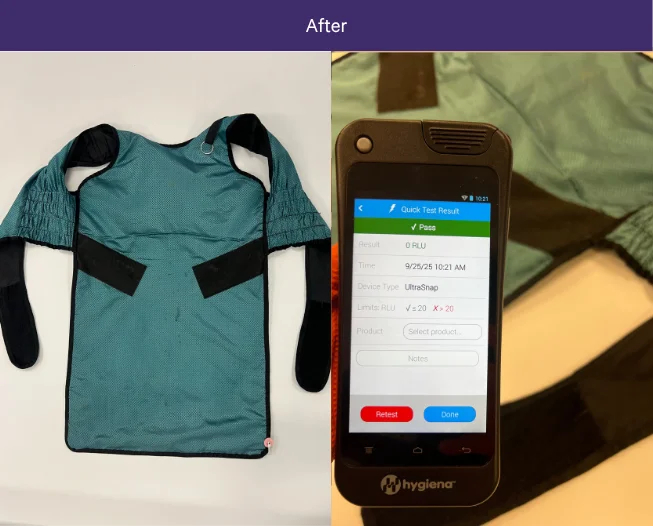
ATP Results
0 RLU
Protective Material Damage Found
RCS’s inspection process detected severe damage in a sensitive area of a skirt being
used consistently by clinicians.


Why Annual Lead Garment X-ray Inspections Are Critical
Damaged X-ray garments expose staff to unknown radiation. Regulators require annual inspection of all lead protective equipment to verify integrity. Visual and tactile inspections alone are scientifically proven to inconsistently detect cracks that compromise protection. Only radiographic inspection reliably reveals the hidden defects that put healthcare workers at risk.
Before
ATP test failed (1,363 RLUs), indicating residual bioburden and contamination.
Recommended threshold is 20 RLUs or less.
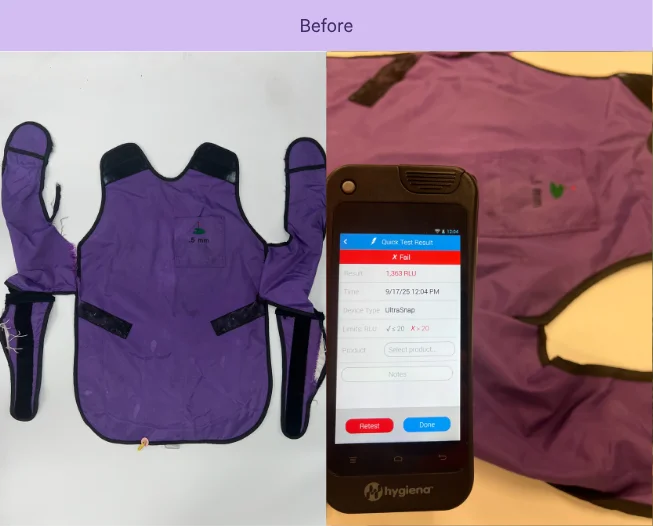
ATP Results
1,363 RLU
After
ATP test passed (10 RLUs), with all stains and bioburden removed.
Results demonstrate the effectiveness of the two-step deep cleaning process.

ATP Results
5 RLU
The Wipe Test
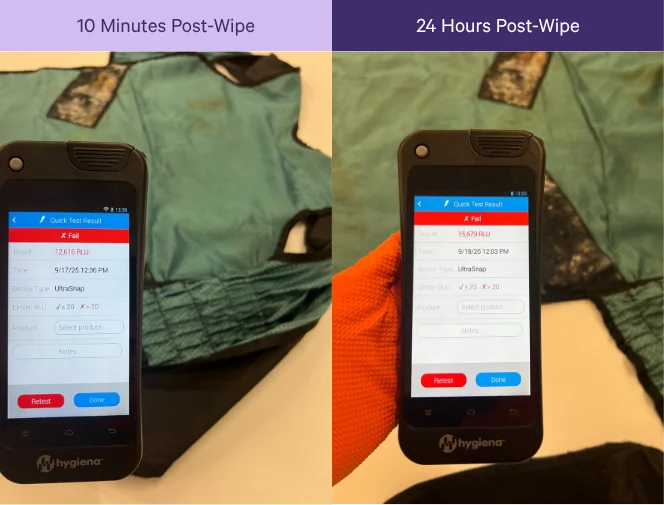
To demonstrate the difference in effectiveness between using wipes and deep cleaning, we wiped the dirty garment before it went through our deep cleaning and disinfection process and then conducted ATP testing. We performed ATP tests on the garments 10 minutes and 24 hours after the use of wipes.
ATP test failed (12,616 & 15,697 RLUs), indicating biofilms likely present and microorganisms are replicating after only using wipes. Recommended threshold is 20 RLUs or less.
Why Wipes Don’t Work
“When facilities only use wipes on a surface and don’t completely remove the debris, they
are in essence creating an ‘all you can eat buffet’ for the surviving bacteria to thrive upon.”
Dr. Kathleen Jones, Infection Disease Specialist
There are two primary reasons:
- Wipes don’t break down biofilms to thoroughly clean the garment before disinfection.
- Wipes are used inconsistently, resulting in a buildup of bacteria over time.
There are two primary reasons:
Biofilms are invisible layers of bacteria that cling tightly to surfaces, shielding harmful microbes from disinfectants and making them far more challenging to kill. The National Institutes of Health (NIH) reported that biofilms are involved in 65% of microbial infections and 80% of chronic infections.
Wipes give the illusion of cleanliness, but when it comes to biofilms, research finds that they’re ineffective. Even if some bacteria are killed, the biofilm’s protective matrix often stays in place, creating a favorable environment for surviving germs or newcomers to repopulate.

Staph aureus, Pseudomonas aeruginosa, Klebsiella pneumonia, Enterococcus faecalis and Coagulase-Negative Staphylococci lived on over 80% of the 218 garments tested and 90% of the thyroid collars. La Fauci et al. (2016)

Pathogens such as Coagulase-negative staphylococci, Enterobacteriaceae, and Staphylococcus aureus appeared on 100% of the 29 thyroid shields tested from three teaching hospitals. McAleese et al. (2020)

Staphylococcus aureus and Tinea species (Ringworm) were on 84% of the 21 garments tested. Three Staph aureus isolates were confirmed to be methicillin-resistant (MRSA). Jaber et al. (2014)
Also… The Smells? The Stains?
Let’s be honest: wipes don’t erase that lingering odor or questionable stain from the last shift.
Ready To Say Goodbye To Filthy Lead?
Related Content

800 Bed Community Hospital – Indiana
800 Bed Community Hospital | Indiana | Standardization & Compliance A community hospital system in Indiana approached RadCare Services with three facilities and a unified goal: to align everyone under the same compliance program. Their lead garment program was scattered across sites with no standardized inspection process, no shared compliance documentation, and no single point […]
Large Pediatric Hospital – Texas
Large Pediatric Hospital | Texas | Cleanliness A nurse manager at a large pediatric hospital in Texas knew their garments were gross. The harder problem was convincing everyone else, including the physicians who wore them every day around their patients. As part of a trial, she sent a few pieces to RadCare Services (RCS). ATP […]
Teaching Hospital – Wisconsin
Teaching Hospital | Wisconsin | Cath Lab | Compliance A prestigious teaching hospital in Wisconsin had been expanding their RadCare Services program one department at a time. When it reached the Cath Lab, the cardiovascular surgeons pushed back. They wear their lead all day, and handing it over didn’t sit well. Once the service was […]

The Annual Cost of X-ray Garment Management
A new RCS hospital was previously performing in-house integrity scanning, cleaning, and documentation for 508 lead pieces across nine departments.

Garment Repairs & Replacement Costs
After the Covid-19 pandemic, a midwestern level-one teaching hospital was struggling with staff shortages and fell behind on the cleaning and maintenance of their radiation protection equipment.